
LPS News
Quick District Information:
School Committee
Job Openings
Lexington Public Schools Health and Safety Notices: H1NI Influenza (Swine Flu) Information
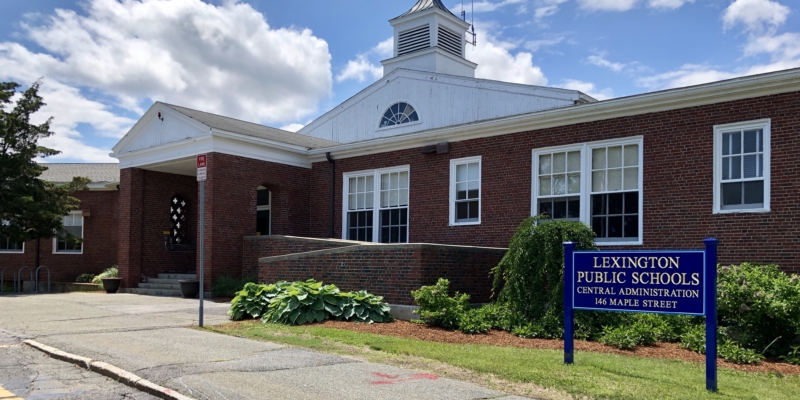
School Administration Offices are located at 146 Maple Street .
Vehicle Access via 328 Lowell Street
Recent Reports:
NEW! Report on Full-day Kindergarten (presented June 16, 2009)
NEW! Update: Year 2 Science Curriculum Review - Executive Summary and Presentation (presented June 16, 2009)
NEW! Update: Year 3 Mathematics Curriculum Review - Executive Summary and Presentation (presented June 16, 2009)
NEW! K-12 Educational Technology Review Report (presented June 2, 2009)
NEW! Update: Year 3 Physical Education and Wellness Curriculum Review - Executive Summary and Presentation
(presented May 19, 2009)
NEW! Fiske to Bridge Redistricting (approved by the School Committee May 19, 2009)
FY 09 Third Quarter Financial Report
FY Action Plan for Equity and Excellence - May 2009
Other School Information:
School Cancellations
Transportation Information
Financial Assistance Program Overview (updated for FY 09-10)
Financial Assistance Application (updated for FY 09-10)
School Lunch Program
Superintendent's Bulletin - June 15, 2009
From the Office of the Superintendent of Schools, Paul B. Ash. Ph. D.
Our Schools: Equity and Excellence in the Lexington Public Schools, May 14, 2009
by
Mr. Vito Lamura and Dr. Steven Flynn,
Co-Chairs
Equity and Excellence Task Force
In January 2008, after the publication of the report, The Achievement Gap in the Lexington Public Schools: Documentation, Research, and Recommendations, Superintendent Paul Ash made it clear that the status quo was academically, socially, and morally unacceptable. The shocking over-representation of METCO students in special education programs and the significant gaps in achievement among African American and Hispanic students when measured against their White and Asian peers were two realities that had to be changed. The Superintendent charged an Achievement Gap Task Force with creating a research-based Action Plan for closing those gaps (equity) while improving achievement for all students (excellence).
Two fundamental, research-supported truths drove the Task Force's efforts: (1) the educational best practices that produce narrowing and closing of racial, ethnic, and socio-economic achievement gaps are also the practices that will improve achievement for all students, and (2) academic ability is developable, not fixed by aptitude or biological endowment. The fact that academic ability is malleable means educators will close the gaps in achievement among different groups of students when they have effectively taught all students how to learn by using high-quality teaching and instruction of rigorous, relevant curriculum in every classroom.
The Task Force began its work of coordinating, reviewing, and refining the work of the Action Plan's multiple authors in March 2008, submitted the plan to the Superintendent's leadership team in April 2009, and presented the Action Plan for Equity and Excellence to School Committee and the public on May 5, 2009. Each of twenty-six separate action items includes the person(s) responsible, a timeline, benchmarks/performance targets, budgetary implications, and accomplishments to date. Planning and implementation began in FY08 and will continue through four phases until FY11. Taken together the actions represent a unified, coordinated plan with five major themes:
1. Providing adequate and/or extended time on learning for all students
2. Creating a collaborative culture of Professional Learning Communities (PLCs)
3. Developing a data culture that frequently monitors and assesses every child
4. Emphasizing student engagement in the life of the school in addition to student achievement
5. Fostering a vibrant home-school connection
These themes are made specific by the plan's detailed action items, some of which are summarized in the next several paragraphs.
Last fall's implementation of full-day kindergarten and this fall's scheduling of Thursday afternoon literacy/mathematics instruction for under-achieving METCO students in grades 2-5 will provide extended learning opportunities. Creating elementary schedules that provide two hours of literacy instruction and one hour of mathematics instruction on most school days will ensure solid foundations in these skills for all students.
Developing at all schools a master schedule that provides common meeting time for content area teachers will allow PLCs to create the systematic, collaborative process in which curriculum is analyzed, frequent assessments are implemented, and the targeted interventions and/or enhancements needed by every student become part of every teacher's instructional plans.
A data-driven school culture will foster a high level of differentiated instruction by providing easy access and analysis of all relevant achievement data for each and every student. Federal stimulus dollars will be used to expand the district’s data retrieval and management systems and to provide the necessary professional development to ensure that teachers use available data resources on behalf of all students.
Implementing a high school METCO Scholars Program in August 2009 will raise achievement expectations and provide adult mentors for upperclassmen, who will also be trained to provide mentoring for younger high school students. A K-8 METCO Mentoring program will provide the encouragement and caring oversight that Boston students need to achieve at higher levels.
Holding parent workshops in Boston on topics such as homework assistance, teacher conferences, home-school communication, and literacy/mathematics support will enhance parents, abilities to monitor their children's achievement. Seeking frequent feedback from parents will ensure the effectiveness of outreach workshops and help determine parents' changing needs.
What are the next steps for the newly named Equity and Excellence Task Force? By September 2009, the responsible person(s) for each action item in phases 3 and 4 must provide timelines, benchmarks, budgetary implications, and an implementation and monitoring plan. That plan for each action already in process must be reviewed and improved. This work is never actually completed; research and experience will no doubt demand revision and adjustment. Our commitment, however, is unchangeable. Each and every child must be the beneficiary of the Action Plan for Equity and Excellence.
Click here to download the full text of this article.
Vito LaMura is Co-Chair of the Equity and Excellence Task Force, past president of the Lexington Education Association, and a retired social studies teacher at Diamond Middle School.
Dr. Steven Flynn is Co-Chair of the Equity and Excellence Task Force and the principal of Clarke Middle School.
Click here to read past issues of the "Our Schools" series and other messages from the Office of the Superintendent.
Last Updated: Tue Jun 23 08:31:38 2009